
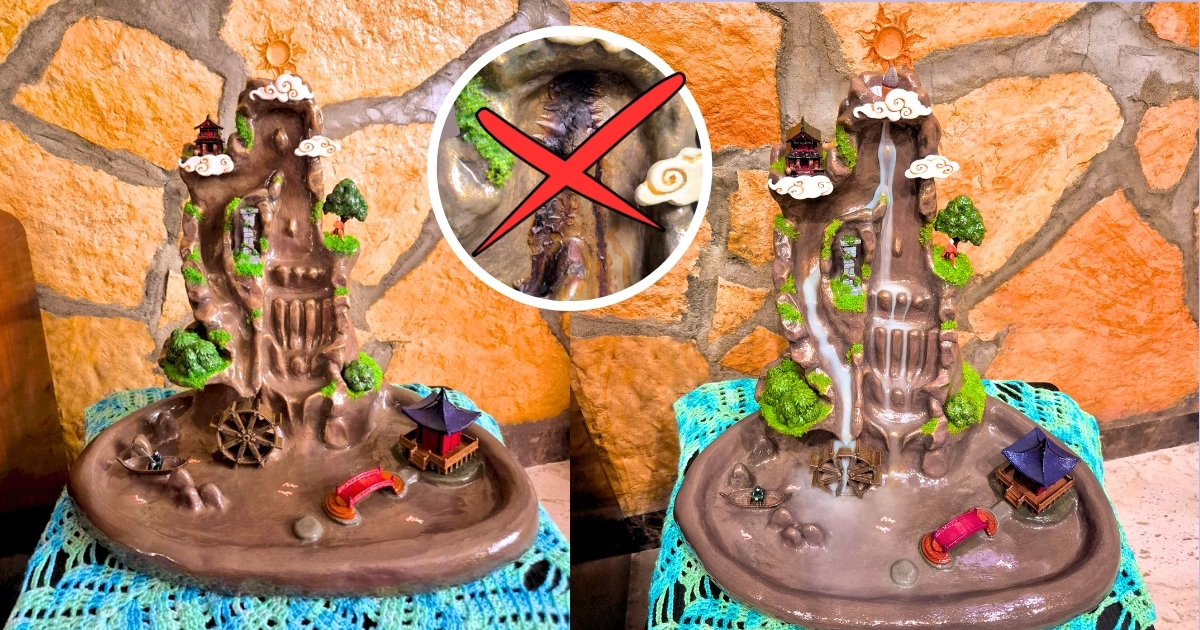
Incense fountain with air dry clay looks like the perfect DIY project. They are aesthetic, peaceful, relaxing, and honestly, they seem pretty simple to make: sculpt a small fountain, paint it, seal it, place a backflow incense cone on top, and watch the smoke flow down like a tiny mystical river.
That was exactly the idea.
I made one using air dry clay. At first, it looked good. The shape worked, the smoke flowed, and the whole thing had that handmade charm I wanted. But after using it over time, I realized something important: air dry clay is not a good long-term material for incense fountains, especially if you want the fountain to stay clean, safe, and nice-looking.
The problem is not only the heat. It is the combination of heat, smoke, sticky residue, paint, and varnish.
And that combination is brutal.

The Story Behind the Fountain
Before talking about why air dry clay was not the best material for this project, I think it is important to explain why I made this incense fountain in the first place.
This fountain was a gift for my father.
My dad has always loved incense. Since I was little, he would often burn incense at home, especially on weekends. After working hard all week, he would finally take some time to rest, read books, and enjoy a calmer atmosphere. But before that, he would light incense to perfume the house, often with warm scents like musk.
Because of that, incense became a very emotional smell for me. Whenever I smell it, it immediately brings me back to my childhood. It reminds me of home, quiet weekends, and my father finally getting a moment to relax after a long week.
So when I discovered backflow incense fountains, I knew it would be a perfect gift for him. It was not just about the incense itself. It was also about the way the smoke falls down like a waterfall. It felt peaceful and I knew he would enjoy that.
That is why I chose a mountain design. I wanted the smoke to become part of the scenery, almost like water flowing down a mountain. Instead of making a simple incense holder, I wanted to create a small world around the smoke.
For the decoration, I also wanted the fountain to match my father’s tastes. Since he was a child, he has been fascinated by China, martial arts, and martial arts movies. He loved Bruce Lee and Jackie Chan, and he even wanted to be like Bruce Lee when he was younger. He practiced different martial arts during part of his life, so I wanted the fountain to reflect that side of him too.
The design became a Chinese-inspired mountain landscape, with little details like a pagoda, bushes, a column, a bridge, a small boat, a water wheel, a tree, a chinese house and a sun at the top. Most of the decorative elements were 3D printed from models I found online, then painted and added to the piece.
The idea was simple: the incense smoke would fall like a waterfall through the mountain, turning the whole fountain into a peaceful miniature scene.
And honestly, at first, it worked. It looked beautiful, personal, and meaningful. As a gift, it made sense.
But over time, I realized that even if the idea was good, the material choice was not.
Air dry clay made the project accessible and easy to sculpt, but it was not strong enough for the long-term reality of a functional incense fountain.

The Smoke Is Not Just Smoke
One of the biggest issues with backflow incense fountains is that the smoke is not as harmless to the surface as it appears. Visually, backflow smoke looks soft, slow, and almost weightless. It moves like mist or water, which is exactly what makes these fountains so beautiful. However, the smoke also carries fine particles, oils, fragrance compounds, and combustion residue from the incense cone.
Over time, these residues settle onto the surface of the fountain, especially along the path where the smoke repeatedly flows. This can cause visible staining, discoloration, and a slightly oily or sticky buildup. The effect may not be obvious after one or two uses, but with repeated burning, the residue gradually accumulates. Areas that are directly in the smoke path often become darker, duller, or brownish compared to the rest of the piece.
This problem is even more noticeable on light-colored surfaces, pastel paint, white details, or glossy finishes. Glossy varnishes and resin coatings can make the residue more visible because they reflect light and highlight any uneven staining or sticky buildup. Instead of protecting the piece permanently, these coatings can sometimes become part of the problem when they react badly to heat and incense residue.
The issue is that backflow smoke is not the same as clean steam or water vapor. It comes from burning material, so it naturally contains substances that can cling to surfaces. Because the smoke is designed to be dense and heavy enough to fall downward, it stays close to the fountain and has more contact with the surface. This repeated contact is what makes the smoke path vulnerable over time.
For air dry clay, this is especially problematic. Air dry clay is porous and not vitrified like ceramic. If it is left unsealed, it can absorb stains and smells. If it is sealed with varnish, resin, or acrylic medium, those coatings may soften, become tacky, discolor, or peel after repeated exposure to warm smoke and residue.

Paint and Varnish Can Soften Over Time
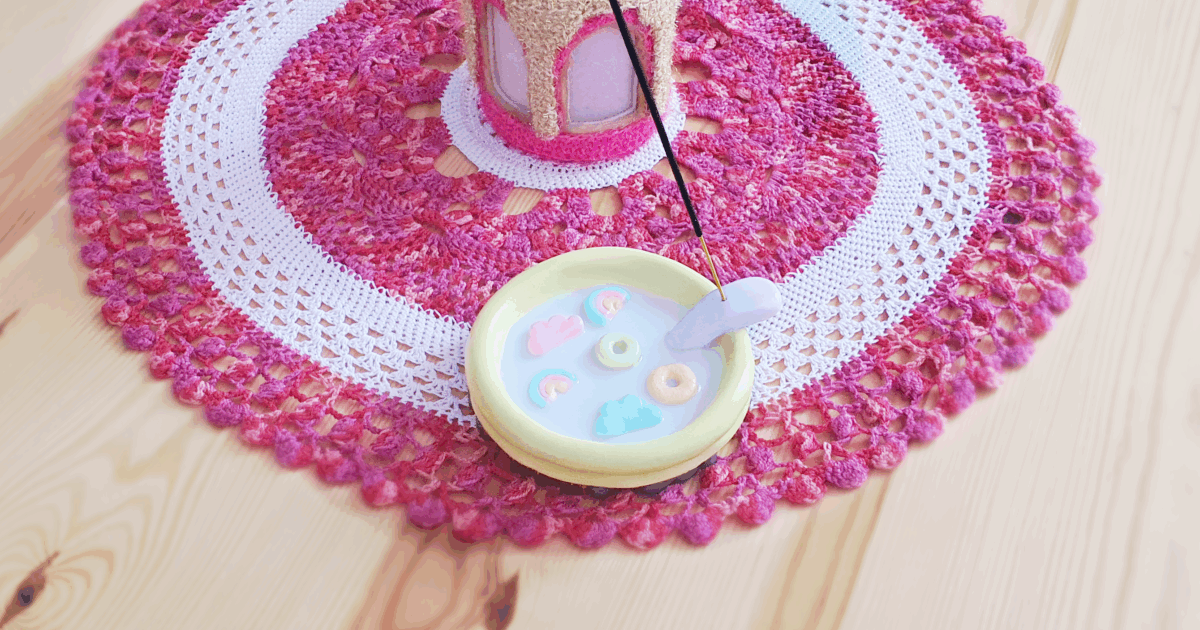
On my old fountain, the paint and varnish did not stay intact. In the smoke path, the glossy varnish started to soften and melt, and eventually the acrylic paint underneath began to peel as well. Instead of staying smooth and clean, the areas where the smoke flowed became sticky, damaged, and difficult to fix. As the finish broke down, it also started to release unpleasant smells, which made me worry about the fumes coming from the heated varnish and paint. Even if the fumes are not always visibly obvious, heating craft coatings that were not designed for this kind of use can release irritating or potentially harmful vapors. What looked like a protective finish at first ended up making the fountain age worse and feel less safe to use.
Air Dry Clay Is Not Ceramic
This is the biggest difference.
Commercial incense fountains are often made from ceramic, resin, stone-like material, or other heat-resistant surfaces. Ceramic is especially good because it is fired at high temperature and often glazed. A ceramic glaze is not the same thing as craft varnish. It becomes a hard, glass-like surface.
Air dry clay is different.
Air dry clay is not fired. It dries by evaporation, but it does not become ceramic. It stays more porous, more fragile, and more sensitive to moisture and surface damage.
That means it can: absorb stains, absorb smells, become harder to clean, chip or crack more easily, react badly to repeated heat, and depend heavily on whatever coating you put on top.
And if that coating fails, the clay underneath is exposed.
Cleaning Becomes a Problem
Cleaning is another issue that is easy to underestimate before making an incense fountain.
Backflow cones leave residue, and that residue builds up directly on the smoke path. With ceramic, this is usually manageable because the surface is hard, glazed, and can be wiped down more easily. But with air dry clay, cleaning becomes much more complicated.

If the clay is left unsealed, it can absorb stains, smells, and oily residue. But sealing it does not fully solve the problem either. As explained earlier, varnish can soften or melt over time when exposed repeatedly to warm backflow smoke. Once that happens, the surface is no longer smooth or easy to clean. The incense residue starts getting trapped inside the damaged varnish, making the smoke path sticky, dirty, and almost impossible to wipe properly.
This creates a frustrating situation: the fountain needs to be cleaned, but the material cannot handle much water, and the protective coating can break down with use. Instead of making the fountain more durable, the varnish can end up making the residue harder to remove.
That is why air dry clay is not practical for a functional incense fountain in the long term. It may look good at first, but once residue and heat start affecting the surface, maintenance becomes difficult and the piece ages badly.
So, Should You Never Use Air Dry Clay?
Not necessarily.
Air dry clay can still be used for an incense fountain, but it should be treated as a decorative material, not as the main functional surface. It is useful for sculpting the overall shape, building the mountain, and creating the visual design, but I would not rely on it alone for the areas that are exposed to heat, smoke, and residue.
If I were to make this project again, I would use air dry clay only for the body of the fountain and protect the working parts differently. The cone should sit on a metal or ceramic holder, not directly on painted or varnished clay. The area around the cone should stay free of varnish, resin, or thick acrylic paint, because this is where the heat is strongest.
For the smoke path, I would avoid glossy finishes completely. A better option would be a dark, matte surface that is easier to retouch when it stains. Plaster or another mineral coating could also be used over the smoke channel, since it is less likely to soften than varnish or resin. If paint is used, it should be applied in thin layers, preferably in a darker color, instead of relying on a shiny protective coat.
A better DIY approach would be:
- air dry clay for the decorative structure;
- a metal or ceramic holder for the incense cone;
- no varnish, resin, or glossy coating near the hot area;
- a dark matte smoke path that can hide staining better;
- plaster or another mineral coating where the smoke flows;
- possibly heat-resistant paint for the most exposed areas;
- and no UV resin, glossy varnish, or craft sealer in the smoke channel.
Basically, air dry clay can work for the shape and appearance of the fountain, but not as the exposed working surface. For a piece that will actually be used, the parts touched by heat and smoke need to be treated as functional zones, not just decorative ones.
Conclusion – Incense Fountain With Air Dry Clay
Making a DIY incense fountain with air dry clay sounds like a fun and easy project, but long-term, it is not the best material for the job. The combination of hot incense, backflow smoke, oily residue, paint, varnish, and cleaning issues makes it unreliable.
My old fountain taught me that the hard way. The paint and varnish softened, the finish failed, and even UV resin did not survive over time.
So if you want something purely decorative, air dry clay is fine.
But if you want a real incense waterfall burner that you can use often, clean easily, and keep looking good, air dry clay is probably not the right choice.
It is cute. It is accessible. It is fun to sculpt.
But for incense smoke?
It is a little too fragile for the job.























0